
The Bridge Builder
Thabang connects people and systems, linking policy with practice, government with citizens, technology with ethics, and experience with the next generation.
Unique Digital Governance Approach
Living Governance
Living Governance treats governance as a living, adaptable practicenot a static set of frameworks. It is human-centered, outcome-driven, and designed to flex as context, risk, and citizen needs evolve.
“Governance in Action” Interactive Simulator
A simplified, browser-based module where visitors can test how ICT governance decisions hold up under pressure. By adjusting variables like budget cuts, technology disruption, or new compliance demands, the simulator shows how a resilient governance model reallocates responsibility, updates decision rights, and protects service continuity.
“Policy-to-People” Timeline
A clear, visual journey tracing a real examplethe Provincial Digital Content Strategyfrom policy draft to Cabinet approval, implementation across departments, and finally to measurable citizen impact. Each stage highlights who was involved, which governance checkpoints mattered most, and how data and feedback loops improved outcomes over time.
Ethical AI Decision Tree
This visual decision tree shows how Thabang integrates ethics into AI and ICT decisionsfrom first assessing impact on people and rights, to designing governance controls, and mentoring teams to apply the same lens in their own work.
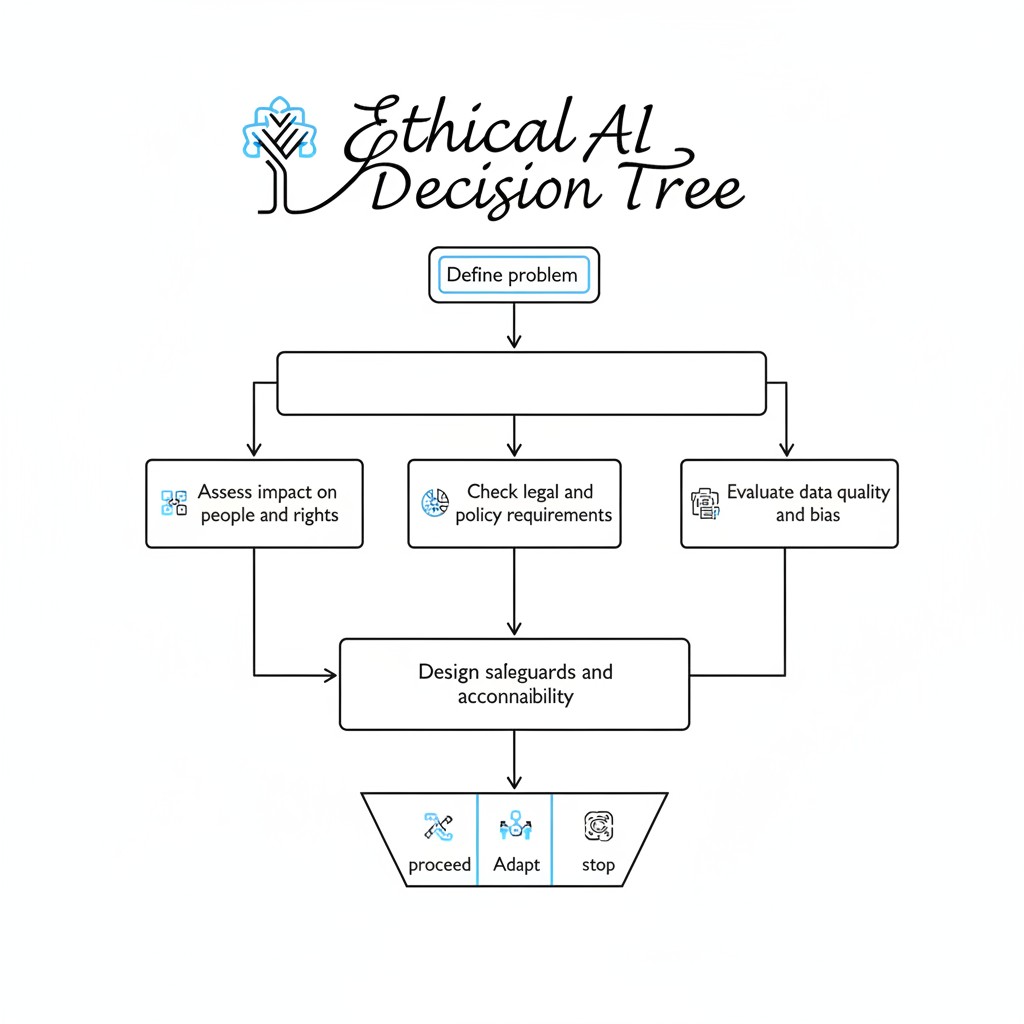
How the decision tree works
1. Start with the problem and who is affected.
2. Check alignment with law, policy, and institutional values.
3. Interrogate data sources for bias, harm, and blind spots.
4. Design safeguards: human oversight, escalation paths, and transparent documentation.
5. Decide whether to proceed, adapt, or haltand record the rationale.
Mentorship in AI ethics
Thabang uses this decision tree as a teaching tool in mentorship, workshops, and executive briefings, helping teams move from abstract principles to concrete, repeatable decisions that protect people, institutions, and long-term trust.
Three-Layer Governance Model
A simple, layered view of how strategy, operations, and people work together to keep digital governance aligned, practical, and human-centered.
Strategic Layer
EXCO, PFMA, and policy direction set the guardrails: why we invest, what value we must protect, and which risks we cannot accept.
Focus: vision, mandates, funding, and accountability.
Practical Layer
SITA management and project teams translate strategy into deliverydesigning, procuring, and implementing systems and services that actually work.
Focus: projects, processes, architecture, and service quality.
Human Layer
Skills development, mentorship, and lecturing ensure people can navigate governance, technology, and ethics with confidence.
Focus: capability building, culture, and long-term leadership.
Who I Am
Strategic thinker with a passion for digital transformation, policy innovation, and developing the next generation of IT and data professionals.
What I Do
I connect policy, technology, and leadership to help institutions design resilient, citizen-centered digital governance.
Featured Insight
Integrating AI Ethics into Public Sector Governance: A Framework for South Africa
Highlight Reel
Strategy in action
Led a provincial digital content programme to strengthen citizen engagement.
Executive keynote
Aligned leadership, risk, and citizen value in large-scale digital initiatives.
Governance in practice
Linked ICT governance frameworks with real-world public sector case studies.
Mentorship outcomes
Guided mentees from analyst roles to trusted, governance-aware advisors.
Testimonials Carousel
“Thabang possesses a rare blend of strategic foresight and practical execution skill. His work on the Provincial IT Council set a new standard for governance.” – Elsabe Rockman, Former Director General, FSPG “An exceptional mentor who bridges theory and practice with clarity and integrity.” – Mentee, Phambili Analytics 
Latest Updates
- Jan 2025: Appointed Part-Time Lecturer, Central University of Technology
- Sep 2025: Joined Advisory Board, World Changers Organisation
- 2026: MBA & Research Communications Fellowship in Progress

Mentor Corner
A dedicated space for Q&A and mentorship, featuring monthly live or recorded sessions and inspiring stories from mentees who’ve achieved tangible progress.
Leadership Journey
This timeline highlights career progression from SABC to Director, connecting leadership roles across government, academia, media, and mentorship.


Policy and Tech
I help government leaders and private sector partners navigate digital governance, delivering resilient, citizen-centered outcomes.
Services Overview
We design governance frameworks, map digital roadmaps, and implement measurable performance metrics for public sector modernization.
Our approach blends leadership coaching with digital transformation programs for cross-agency collaboration and accountable governance.
Testimonials
Alex Rivera, Director of Digital Services
“Partnering with Thabang gave us a clear, actionable digital roadmap that aligned multiple agencies around the same priorities.”
— Aya Nakamura
Maria Chen, Programme Lead
“Thabang’s guidance sharpened our focus, helping us choose the right initiatives and demonstrate measurable results to leadership.”
— Mateo García
Jordan Lee, Service Delivery Manager
“We now deliver digital services faster and with greater user satisfaction, while reducing governance and delivery risks.”
— Lila Patel
Latest Updates
- Jan 2025: Appointed Part-Time Lecturer, Central University of Technology
- Sep 2025: Joined Advisory Board, World Changers Organisation
- 2026: MBA & Research Communications Fellowship in Progress
Mentorship Map
This simple map shows how a typical mentee develops over timefrom first contact, through structured learning and real-world practice, to becoming a confident, ethically grounded professional.
1. Entry
Clarifying goals, current experience, and the kind of professional the mentee wants to become.
2. Skill-building
Targeted development in core areas like analysis, communication, governance practice, and digital tools.
3. Real-world application
Applying learning to live projects, presentations, or stakeholder engagements with guided feedback.
4. Ethical decision-making
Using structured reflection and tools like the Ethical AI Decision Tree to navigate complex choices.
5. Outcome
A confident, values-driven practitioner who can bridge policy, technology, and people with integrity.
- Each step can be adapted to the mentees pace and context, with regular check-ins to review progress.
- Milestones are visible and practical, so mentees always know where they are and what comes next.
Case-Based Learning Portal
Explore anonymized, real-world government datasets designed for practice. Each case invites mentees to analyse, interpret, and communicate insights as if reporting to senior public sector leaders.
Case 1: Service Delivery Dashboard
An anonymized provincial dashboard with indicators for health, education, and local government performance across districts. Mentees practice prioritising issues, surfacing trends, and crafting a short briefing note for executives.
Case 2: Citizen Feedback & Complaints
A cleaned, anonymized dataset of citizen complaints, compliments, and queries across multiple channels. Mentees group themes, identify systemic risks, and propose governance responses that balance transparency, accountability, and capacity.
Case 3: ICT Project Portfolio
An anonymized portfolio view of ICT projects with budgets, timelines, and risk flags. Mentees practice reading for governance signals, spotting misalignment with strategy, and preparing recommendations for a portfolio review meeting.
Cross-Sector Wisdom Transfers
09 Learn to plan and use money carefully so resources are used where they matter most.09 Keep records clear, accurate, and easy to check.09 Write reports that explain what was done, why it was done, and what it cost.09 Base important decisions on facts and evidence, not guesses.09 Use dashboards, logs, and audit trails so people can see how things are working.09 Explain how decisions are made in simple, honest language.09 Share key information openly so people can understand and trust the process.09 Help citizens get information that affects their lives and services.09 Support leaders with clear summaries so they can make informed choices.09 Guide teams to follow good data practices in their daily work.09 Give auditors what they need to check that systems are fair and reliable.09 Present data in a way that is easy to read, compare, and discuss.09 Use real examples from projects, audits, and system changes to explain lessons.09 Ask often whether your data choices are open, fair, and responsible.09 Treat every data decision as a chance to protect public trust.
Lessons from Government on Data Leadership
– Learn to use resources wisely – Share information openly – Support teamwork – Build important skills for future leaders
Fiscal Discipline and Accountability
Learn to plan and use money carefully so resources are used where they matter most.
Transparency by Design
Use dashboards, logs, and audit trails so people can see how things are working and how decisions are made.
Balancing Stakeholder Needs
Help citizens, leaders, staff, and auditors get the information they need in a way that is clear, fair, and easy to understand.
Use real examples from projects, audits, and system changes to explain why good data leadership matters.
Ask whether your data choices are open, fair, and responsible, and adjust your actions when they are not.
- Keep sections short and concrete so mentees can quickly connect lessons to their own work.
- Return to these three anchors when reviewing project plans, data models, or AI use cases with teams.
From Cabinet Notes to Board Packs
Mentees practice turning complex topics into short, easy summaries. Examples: – Reports for executives (EXCO) – Updates for committees – Briefings for boards
Stakeholder Mapping & Messaging
With government communication tools, mentees: – Find stakeholders – Predict what people care about – Adjust messages for different groups
Ethics, Trust, and Reputation
Public sector lessons include: – Being open about mistakes – Sharing risk honestly – Protecting trust and reputation These ideas also fit corporate governance and stakeholder work.
 The Strategic Communicator & Digital Governance Architect